
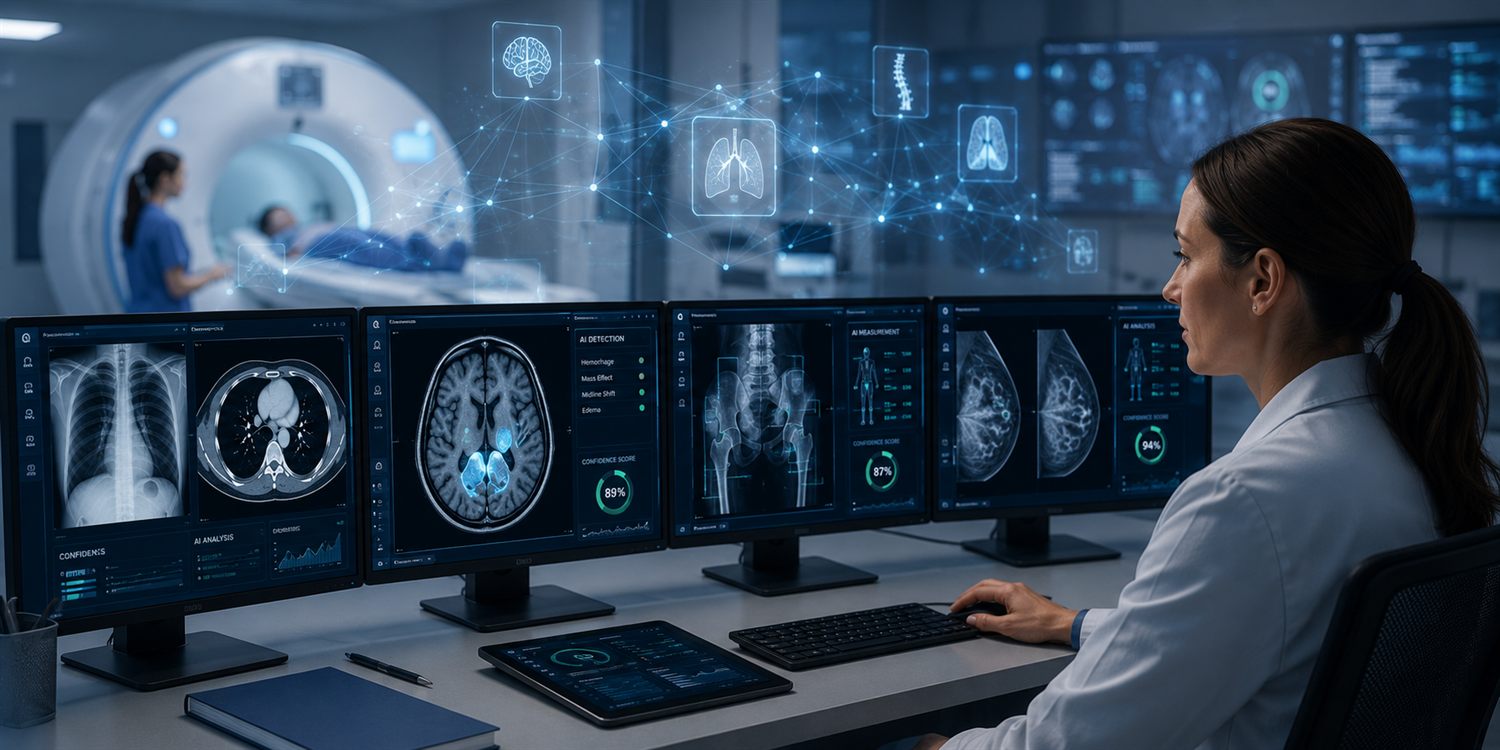
AI healthcare decision-support software
Our portfolio includes the artificial-intelligence radiology systems of three vendors: Gleamer, DeepHealth and Brainomix. Each brings a different strength — accelerating day-to-day reporting, serving population screening programmes, and supporting acute stroke care — and together they cover the most important areas of diagnostic imaging, from X-ray through CT and MRI to mammography and ultrasound.
Embedded in the radiology workflow, these systems help specialists increase reporting efficiency, reinforce diagnostic decisions and deliver more consistent patient care.
Important
The modules fit into the existing radiology workflow: studies arriving in the PACS are analysed automatically, and the reporting physician receives the results in their usual viewer — with no separate workstation or parallel system. Deployment, integration and support are handled by us.
Three vendors, one portfolio
| Vendor | Focus | Modalities |
|---|---|---|
| Gleamer | A radiology copilot for day-to-day reporting — trauma, chest, musculoskeletal, breast, neuro | X-ray, CT, MRI, mammography |
| DeepHealth | Population screening programmes and complete care pathways | mammography, CT, MRI, ultrasound |
| Brainomix | Acute stroke care and interstitial lung disease | CT, CT angiography, CT perfusion, MRI |
Gleamer — a copilot for day-to-day reporting
The Gleamer modules add a second read alongside routine imaging studies: they flag suspicious areas automatically and perform recurring measurements. They deliver the most value in high-volume, repetitive work — emergency X-ray, chest screening, musculoskeletal follow-ups.
| Modality | Module | What it supports |
|---|---|---|
| X-ray | BoneView | Bone injury and fracture detection |
| BoneMetrics | Automated musculoskeletal measurements | |
| ChestView | Identification of chest pathologies | |
| BoneAge | Bone age assessment | |
| CT | LungCT | Lung nodule detection |
| BoneCT | Secondary bone lesions | |
| MRI | Pixyl.Neuro.MS | Multiple sclerosis lesions |
| Pixyl.Neuro.BV | Brain volumetry, neurodegenerative changes | |
| LumbarMR | Lumbar spine diagnostics | |
| Mammography | BreastView | Breast lesion detection (2D and 3D) |
DeepHealth — population screening and care pathways
DeepHealth does not provide a single module but a suite per organ system: it also handles the follow-up of findings, structured reporting and the patient's onward pathway. It is strongest where the task is to serve a screening programme rather than a single study.
| Suite | Modality | What it supports |
|---|---|---|
| Breast Solutions (SmartMammo) | mammography, breast ultrasound | Breast screening and diagnostics: lesion detection, density and risk assessment, structured reporting |
| Chest Suite (DeepHealth Lung) | CT | Automatic identification and measurement of lung nodules, growth tracking against prior studies, coronary artery calcification scoring |
| Prostate Suite (Quantib Prostate) | prostate MRI | Lesion detection and risk categorisation, automatic gland segmentation with PSA density, PI-RADS-compatible reporting, compatible with fusion biopsy systems |
| Neuro Suite (DeepHealth Brain) | MRI (FLAIR, T1) | White-matter lesion detection, brain volume and atrophy measurement against a normative database, longitudinal follow-up |
| Thyroid Suite | ultrasound | Automatic detection and characterisation of thyroid nodules, standardised ultrasound worksheet, comparison with prior studies |
Tip
The viewer of the DeepHealth suites is developed by eRAD — the same vendor whose PACS system we also distribute. The two worlds therefore fit together naturally.
Brainomix — acute stroke care
Brainomix works against the clock of emergency care: the Brainomix 360 platform evaluates brain scans within minutes and helps decide whether a patient is eligible for thrombectomy or thrombolysis. The system supports decisions and patient transfer not only within a single institution but across stroke networks.
| Module | Modality | What it supports |
|---|---|---|
| Brainomix 360 Stroke | platform | Automatic evaluation of brain scans and support for stroke therapy decisions |
| NCCT | non-contrast head CT | ASPECTS scoring, ischaemic core and net water uptake measurement, large vessel occlusion and intracranial haemorrhage flagging |
| CTA | CT angiography | Automatic vessel occlusion detection, collateral supply scoring, 3D vascular reconstruction for intervention planning |
| CTP | CT perfusion | Perfusion maps and mismatch ratio, identification of patients eligible for thrombectomy |
| MRI | MRI | DWI–FLAIR mismatch analysis, multiple sequences (DWI, ADC, perfusion) on one interface — for late-window cases |
| e-Lung | chest CT | Quantitative assessment of interstitial lung disease |
| Vantage | analytics | Network dashboard for measuring and optimising stroke care |
Further modules
Beyond the above, the emergency CT modules (EmerCT-Chest, EmerCT-Head) and Pixyl.Neuro.TOF (aneurysm detection on TOF-MRA studies) are also available.
Note
AI output is always decision support — the final diagnosis is made by the specialist. The modules do not replace the radiologist's work; they speed it up and reinforce it.
Deployment and support
We do not hand these systems over "off the shelf": before deployment we discuss which modules fit the institution's study profile and volume, then we carry out the PACS integration, the training and the ongoing support. Since image archiving, speech recognition and the AI modules all come from us, we can align the entire reporting pathway from a single source.